
Name Eligibility
Start with certainty.
Know a business name can be registered before your customer commits to it. Naming rules and registry availability in one call, across all 50 states and DC.
Naming rules
Registry availability
Inline fix
Why Name Eligibility

No surprises at the state.
Most rejected formations fail on the name: a missing designator, a restricted word, a name already on file. Palm runs this check on every formation it files. Run it the moment your customer types a name, and they fix it before they pay.
One answer.
Send a name, a state, and an entity type. Get back one answer that covers both the naming rules and registry availability.
A clear reason.
Every failure comes back in plain language, with the statute when one applies. A missing or misspelled designator also carries a fix.
The right severity.
An error stops registration. A word that needs agency sign-off, or a screening advisory, can still come back eligible. Show both to your customer.
How it works
From first draft to final name.
One call returns the decision, the reason, and a correction when the problem has one clear answer. The same rules run again at filing.
Propose
Pass the proposed name, jurisdiction, and entity type as your customer enters it. LLCs, PLLCs, corporations, and professional corporations, in any US state or DC.
See it in action
Decide
Eligible is true only when the name is compliant and available. An empty violations list means the naming rules cleared.
See it in action

Suggested names prompted
A missing designator blocks registration, and the violation says how to fix it. Maple Street Ventures in Texas needs an accepted LLC, so Palm sends recommended additional names back in the API.
See it in action


File
Add suggest=true and Palm returns eligible alternatives. The name your customer picks carries into the formation, where the same rules run again.
See it in action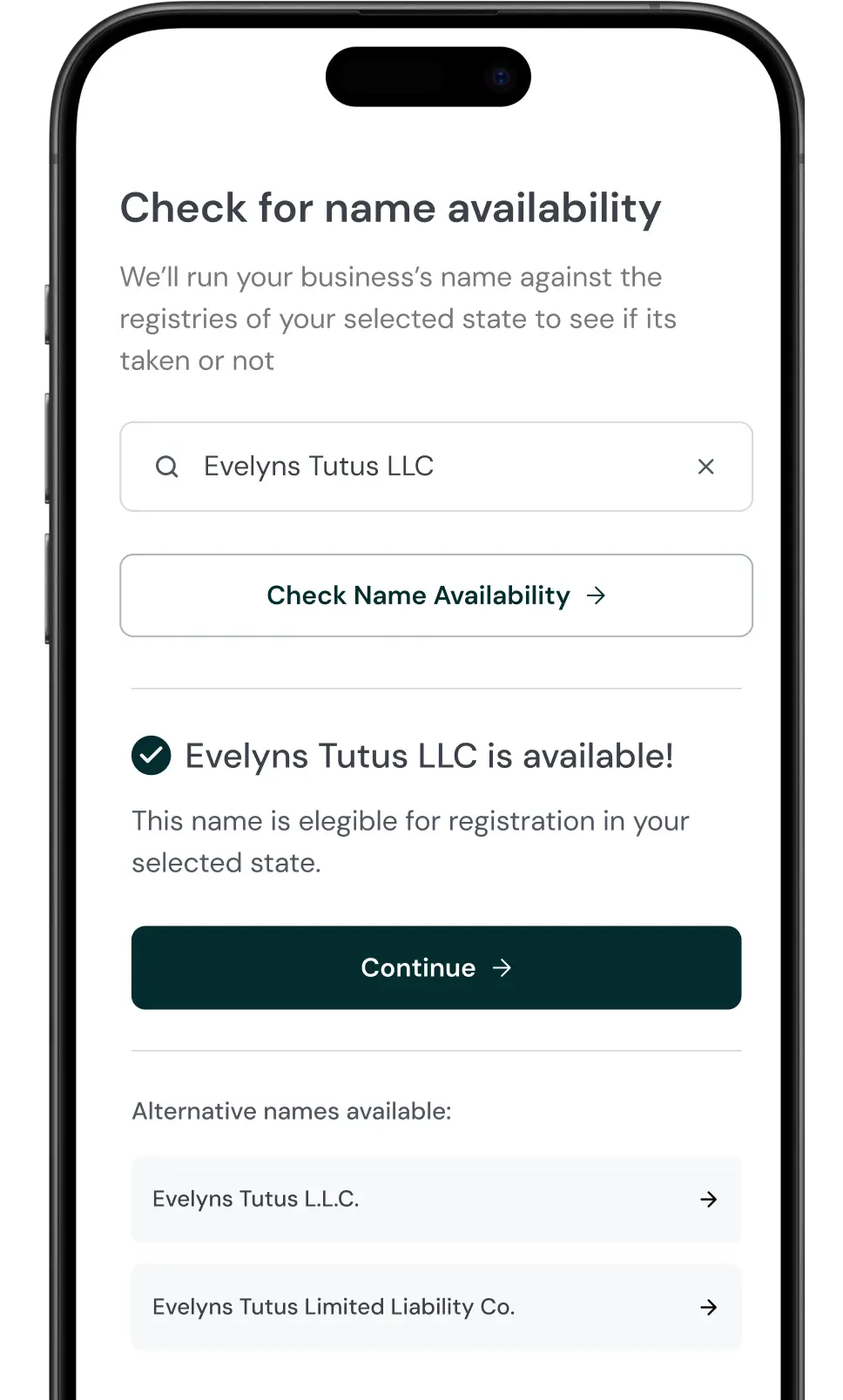
Use cases
Certainty, wherever names start.

Formation products
Clear the name before you file.
Most rejected formations fail on the name. Check it the moment your customer proposes one, not after the state sends it back.
Vertical SaaS
Confidence at the name field.
Show the correction inline, before your customer commits and before you build a formation request.
Accounting & Compliance
The rule, in writing.
Each state sets its own designators and restricted words. Palm returns the rule that failed, in language you can share with the client.
Banks / FIs
Caveats, called out early.
Bank, trust, and insurance in a name can be eligible and still need sign-off from a named agency. Show the caveat, instead of treating it as a hard block.
Marketplaces
Sellers form with confidence.
A seller forming a new entity gets an answer before checkout, with alternatives ready if their first choice is taken.
Incorporation
Names that will register.
Ask for suggestions and Palm returns eligible alternatives. The chosen name carries straight into the formation.
Pricing
Usage-based.
Pay per API call.
No upfront data licenses. No batch refresh fees. Optional tiered annual minimums - higher commitment, lower per-call cost.
Features
Billing
Name Eligibility
Naming-rule compliance and registry availability for a proposed name.
Formations
File the business once the name is eligible. The same rules run again at filing.
State Fees
Secretary of State filing fees are billed at cost. Palm does not mark them up.

Get started
Certainty from name to formation.
The same rules run when you submit a formation, so a non-compliant name never reaches the state. A name that passes here carries straight into Form a Business.